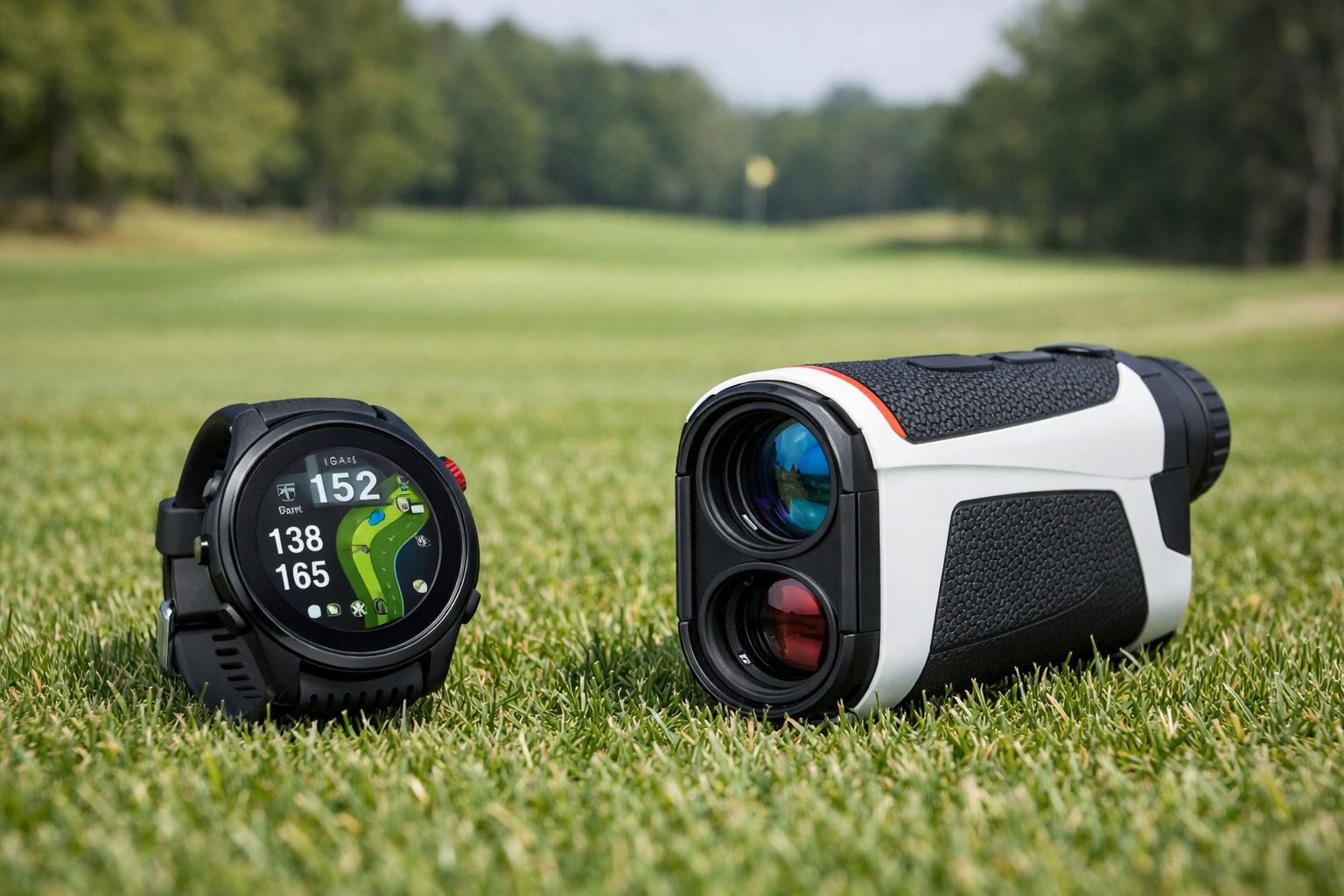
If you’ve ever stood over a 150-yard approach shot and thought “wait, is that to the front or the pin?” — you already understand why golfers obsess over distance devices.
Two tools dominate this space: the GPS watch and the laser rangefinder. Both tell you how far away things are. Both fit in your bag. Both are genuinely useful. But they work completely differently, and the one that’s right for you depends on how you actually play.
Here’s the honest breakdown.
How each one actually works
A GPS watch connects to satellites and uses preloaded course maps to show you distances to the front, middle, and back of the green — plus hazards, layup zones, and sometimes hole layouts. You glance at your wrist and the number is just there. No aiming, no pointing, no fuss.
A laser rangefinder works differently. You point it at a target — usually the flagstick — press a button, and it fires an invisible laser beam that bounces back and calculates the exact distance. Most modern rangefinders lock onto the pin with a little vibration to confirm you’ve got it. You get a precise number to whatever you’re aiming at, not just a general zone.
Same problem — how far is it? — two very different approaches to answering it.
GPS watch pros and cons
The GPS watch’s biggest strength is convenience. You’re never fumbling for a device mid-round — the number is on your wrist before you even think to look. For a casual golfer playing a couple of rounds a month, that frictionless experience is genuinely hard to beat.
The trade-off is precision. GPS gives you front, middle, and back of the green. That middle-of-green number might be 148 yards, but if the pin is cut at the back, you’re actually looking at 156. On most holes that gap doesn’t matter much. On a par-3 over water with the pin tucked behind a bunker, it matters a lot.
Laser rangefinder pros and cons
A rangefinder earns its place when precision matters. That exact pin distance removes the guesswork that costs amateur golfers strokes on approach shots. And the slope feature — which adjusts the yardage based on uphill or downhill elevation — is genuinely game-changing on hilly courses. Most models let you toggle slope off for competition rounds where it’s not permitted.
The downside is real though: if you can’t see the flag, the rangefinder can’t help you. Doglegs, trees, blind approaches — GPS wins those situations every time.
Head-to-head: how they compare
| Category | GPS Watch | Laser rangefinder |
|---|---|---|
| Accuracy | Front/middle/back of green | Exact distance to the pin |
| Ease of use | Glance at wrist — done | Aim, lock, read |
| Blind shots | Works fine | Doesn’t work |
| Slope adjustment | Rare (Arccos is an exception) | Available on most models |
| Course mapping | Full hole layouts, hazards | None |
| Battery life | Needs charging regularly | One battery lasts months |
| Price range | $150–$500+ | $100–$600+ |
| Best for | Convenience-first golfers | Precision-focused golfers |
So which one should you get?
Go with a GPS watch if…
• You want zero friction on the course
• You play a variety of courses regularly
• You care about hazard and hole mapping
• You want an everyday wearable too
• You’re a casual or social golfer
Go with a rangefinder if…
• You want exact pin distance every shot
• You play courses with tricky pin positions
• You want slope adjustment built in
• You play the same course regularly
• You’re working on course management
| The honest take: For most casual golfers, a GPS watch is the better starting point. It’s easier to use, gives you everything you need for a normal round, and adds zero friction to your game. Upgrade to a rangefinder — or add one — when you start caring about that 8-yard difference between pin and middle-of-green. |
What about using both?
Plenty of serious golfers do exactly this — and it makes sense. A GPS watch on your wrist gives you course awareness on every hole: hazard distances, layup yardages, hole layout when you can’t see the green. Then when you’re in the fairway and ready to pull a club, you reach for the rangefinder to lock the exact pin distance.
It’s not overkill if you’re playing regularly and want to tighten up your approach game. But for most casual golfers, one device done well is more than enough.
A few options worth looking at
Garmin Approach S62
One of the best all-around golf GPS watches. Full hole maps, hazard distances, shot tracking, and it doubles as a solid everyday watch.
~$300–$400
Bushnell Tour V6 Shift
The sweet spot in Bushnell’s lineup. Tour-level pin accuracy with slope toggle for competition play. Trusted by serious amateurs everywhere.
~$399
Garmin Approach S12
The best entry-level GPS watch on the market. Simple, lightweight, 42,000+ preloaded courses, and battery life that lasts multiple rounds.
~$150
Blue Tees Series 3 Max
Disrupted the market with premium performance under $200. Slope included, flag-lock confirmed, and it comes in multiple colors. Hard to beat for the price.
~$180
Full reviews of each of these are coming to ParsingPar — but if you’re ready to pull the trigger on one now, any of the four above are solid starting points at their respective price ranges.
The bottom line
GPS watches and rangefinders solve the same problem — knowing your distance — in two fundamentally different ways. GPS is about convenience and course awareness. Rangefinders are about precision to the pin.
For most casual golfers, a GPS watch is the move. It adds zero friction to your round, works on any hole regardless of what you can see, and gives you more than enough information to make smart club decisions. If you start caring about that extra 6 yards between the middle and the back of the green, that’s when a rangefinder earns a spot in your bag too.
Either way, both beat pacing it off from the sprinkler head.
| Up next on ParsingPar How strokes gained actually works — and why it’s the most useful stat in golf that most casual players have never heard of. |
Leave a Reply